
Your nervous system has a dimmer switch
Most of us spend the day running on the sympathetic side of the nervous system: commuting, carpools, inboxes, practice pickups. That "go" mode is useful. But a body that never downshifts pays for it in sleep, digestion, recovery, and pain sensitivity.
Legs up the wall, known in yoga as Viparita Karani, is one of the simplest ways we know to turn the dial toward the parasympathetic side, the "rest and digest" mode. No equipment. No flexibility required. Five to ten minutes on the floor next to a wall.
It looks too easy to matter. The physiology says otherwise. Here's what happens in your body when your legs go up, and how to use it well.
How to do legs up the wall
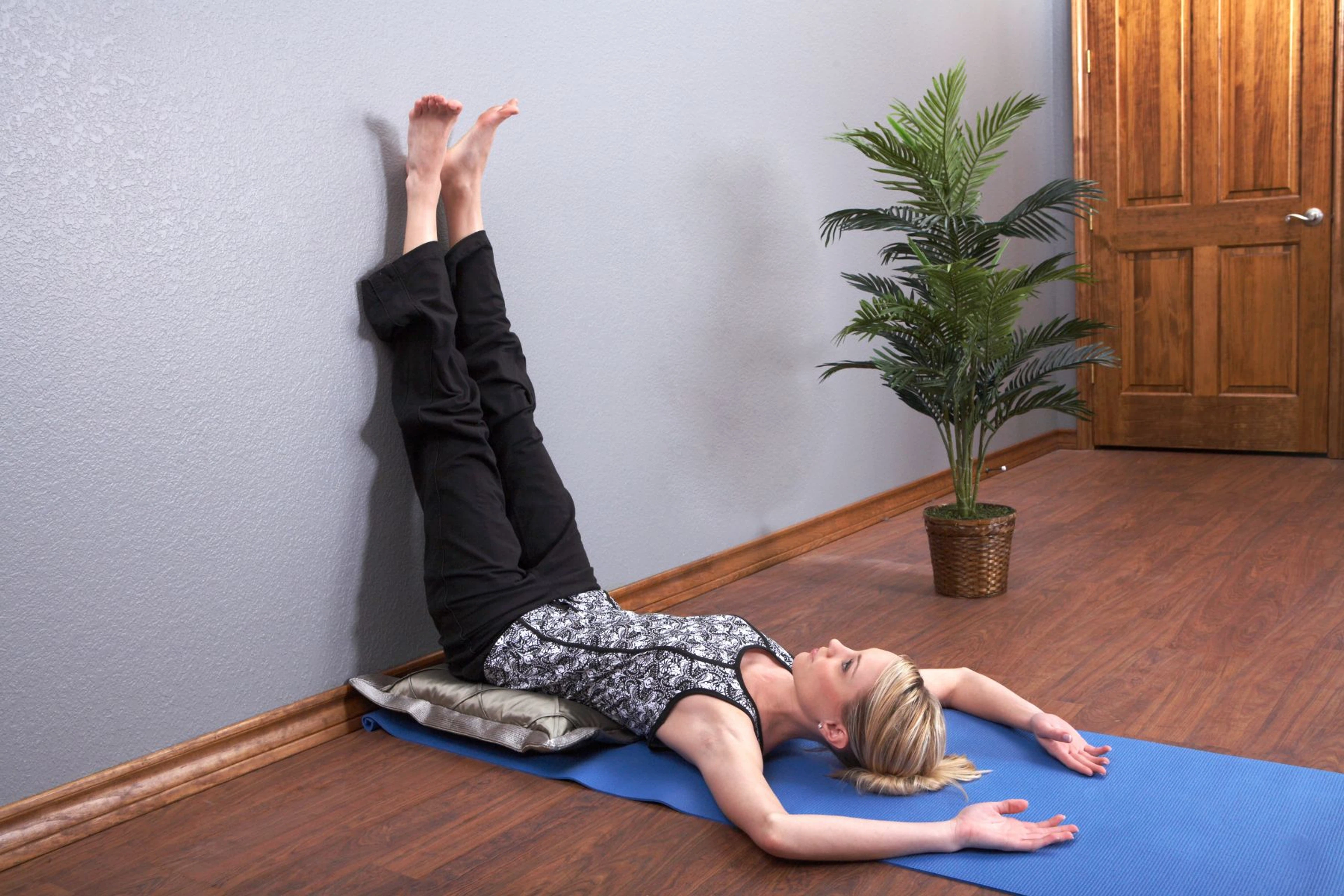
- Set up. Sit sideways with one hip touching the wall. A folded blanket or yoga mat under you makes the floor friendlier.
- Swing and settle. Lower your back to the floor as you swing your legs up the wall. Scoot your seat as close to the wall as is comfortable. Tight hamstrings? Slide a few inches away and let your knees soften.
- Support your head and low back. A small pillow under your head is fine. Some people like a folded towel under the pelvis for a gentle lift.
- Let your arms rest. Palms up by your sides, or one hand on your chest and one on your belly.
- Breathe slowly. Inhale through your nose for about four counts, then exhale for about six. Let the exhale be longer than the inhale.
- Stay 5 to 10 minutes. Then bend your knees, roll to your side, and pause before sitting up. Stand slowly.
When to use it: before bed, after a long day on your feet, after a game or tough training session, or any time you notice you're wound up and can't settle.
Why it works: four overlapping mechanisms
Legs up the wall doesn't do one thing. It stacks four signals that all point your nervous system the same direction.
1. Lying down is a parasympathetic signal
Posture alone changes your autonomic set point. When researchers compare body positions, lying supine favors parasympathetic dominance, while standing shifts the balance toward sympathetic activity and a higher heart rate [1]. As you move from lying to sitting to standing, sympathetic nerve activity to your muscles climbs step by step [2]. Legs up the wall runs that process in reverse.
2. Raising your legs sends blood back toward your heart
With your legs above your heart, gravity helps return blood from the lower body. More blood in the chest stretches pressure sensors called baroreceptors, located in your heart, major vessels, and neck. When those sensors are loaded, your brain reads it as "plenty of volume here" and eases off the gas: sympathetic outflow drops and vagal tone rises [3]. Head-down tilt studies, which mimic this shift, show lower heart rate and blood pressure [3]. Direct stimulation of baroreceptors in the neck produces the same slowing effect [4].
3. Passive legs tell the body it's safe
In the pose, your legs do no work. A study of passive lower-limb movement found sympathetic activity was largely suppressed and vagal activity became dominant, measured by heart rate variability (HRV) [5]. Effortless positioning is a cue that there's nothing to brace against.
4. Slow breathing amplifies the shift
The slow, relaxed breathing that comes with restorative yoga adds its own effect. Yoga is thought to calm the stress-hormone (HPA) axis and the sympathetic system, possibly through direct vagal stimulation, while slow breathing lowers heart rate and blood pressure. Yoga practice has been shown to raise parasympathetic HRV markers and lower salivary cortisol.
The end result: rest and digest
When vagal tone rises, the vagus nerve releases acetylcholine onto the heart's pacemaker cells. Heart rate slows, the heart works less hard, and blood pressure comes down. That's the physical signature of your body switching out of "go" mode.
What the evidence does and doesn't say
We hold our content to a high standard, so here's the honest version: no published study has measured legs up the wall specifically.
What we have is strong evidence for each piece of the mechanism: posture, baroreceptor loading, passive leg positioning, and slow breathing. Putting them together is a reasonable synthesis of well-understood physiology, not a proven claim about this exact pose. Many of the HRV studies are also small and exploratory.
The takeaway: legs up the wall is low-risk, free, and grounded in real physiology. Just don't expect it to replace sleep, strength training, or care for an underlying condition.
Who should skip or modify it
The same blood-volume shift that makes this pose calming is a reason for caution in some people. Check with your provider first if you have:
- Glaucoma or recent eye surgery — leg elevation and head-low positions can raise pressure in the eyes and head.
- Heart failure or a significant heart condition — extra blood returning to the heart is a load, not a rest, for a struggling heart.
- Uncontrolled high blood pressure — get it managed before adding inverted or legs-elevated positions.
- Later pregnancy — lying flat on your back can compress major blood vessels. Try a side-lying rest or keep the torso propped up instead.
- Reflux or a hiatal hernia — a slightly raised upper body is usually more comfortable.
- Low blood pressure or lightheadedness when standing — come out of the pose slowly and sit for a minute before getting up.
Easy modifications: legs resting on a couch or chair seat with knees bent at 90 degrees, a bolster under the hips, or legs slightly apart. You still get the supine and passive-leg benefits with less load.
How we use it at Cape Concierge PT
At CCPT, legs up the wall is a tool, not a treatment plan. We use it where calming the nervous system helps the rest of the work land:
- Pelvic health: a downshift before or after pelvic floor work, especially for patients who carry tension they can't easily release.
- Athletes: a post-game or post-practice wind-down to help teen athletes get out of competition mode and into sleep.
- Chronic pain: a daily, low-effort way to practice turning down a nervous system that's been stuck on high alert.
- Busy women in midlife: a five-minute reset at the end of the day that doesn't require a class, a schedule, or a change of clothes.
What makes the difference is fitting it to you: your history, your body, and what else your plan includes. That's the kind of step-by-step, relationship-based care we build at Cape Concierge PT, in your home or ours, across Cape Cod, Plymouth and the South Shore.
Not sure where to start? Book a Movement Physical, our twice-yearly 3D movement screen, and we'll show you exactly what your body needs, from strength to recovery.
Refer yourself to physical therapy. No one else is going to do it for you.
This post is for education and isn't a substitute for individual medical advice.