
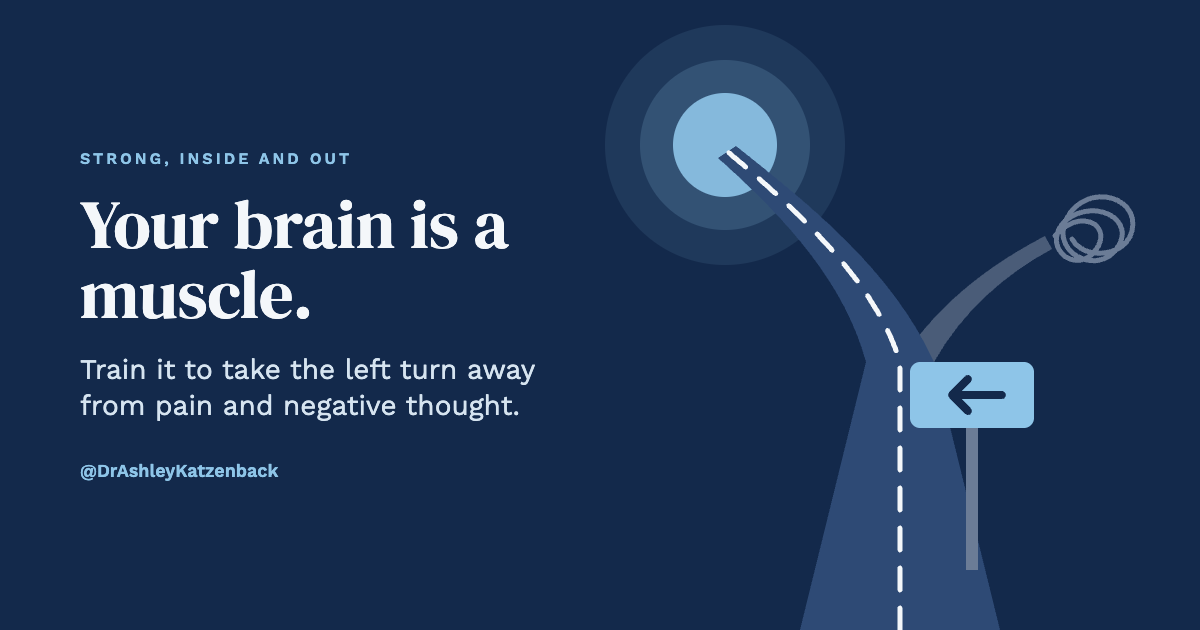
Your brain is always training. The only question is what it's practicing.
We talk a lot about training muscle for longevity. Your brain follows the same rules. What you repeat gets stronger. What you stop using fades. That's true for a squat pattern, and it's true for a thought pattern.
Most people never think of worry, catastrophizing or bracing for pain as "reps." But that's exactly what they are. And just like any training plan, you can change what you're practicing.
Neuroplasticity works both ways.
Pain is real, and your brain produces it.
Your thoughts reach every system in your body.
How to take the left turn.
How we approach this at CCPT
Neuroplasticity is your brain's ability to change its structure and wiring based on what you ask it to do. This isn't a metaphor. In a well-known 2004 study published in Nature, adults with no juggling experience learned a three-ball routine over three months. MRI scans showed measurable increases in grey matter in brain regions tied to visual motion. When they stopped practicing for three months, those gains partly faded.
That's use-it-or-lose-it, at the level of brain tissue.
Here's the catch: your brain doesn't judge whether a pattern is helpful. It strengthens whatever you repeat. Rehearse a fear of bending, and bending gets scarier. Replay the worst-case scenario, and that pathway becomes your default route. Practice noticing the spiral and turning away from it, and that becomes easier too.
Pain is real, and your brain produces it.
This is one of the most important things I teach patients. Pain is real. And pain is produced by your nervous system as a protective output. It is not a direct readout of tissue damage.
Most of the time, those two line up. You sprain an ankle, it hurts, it heals, the pain fades. But when pain sticks around for months, the nervous system itself can become the amplifier. Researchers call this central sensitization. Harvard neuroscientist Clifford Woolf described it as a prolonged but reversible increase in how excitable pain pathways in the spinal cord and brain become. The result is more pain with less provocation.
Woolf's review links central sensitization to a long list of conditions we see every day, including fibromyalgia, osteoarthritis, headaches, jaw pain and post-surgical pain.
The word that matters most there is reversible. A sensitized system can be retrained.
That's also why education is treatment. Lorimer Moseley and David Butler spent more than 15 years studying what happens when clinicians carefully explain how pain works. That approach, often called "Explaining Pain" or pain neuroscience education, is now cited in evidence-based guidelines around the world. Understanding your pain changes your pain.
The mind-body connection doesn't stop at pain. It runs through your whole system.
In Why Zebras Don't Get Ulcers, Stanford neuroscientist Robert Sapolsky explains why. A zebra chased by a lion mounts a huge stress response, then it's over. Humans can trigger that same cascade just by thinking about a hard conversation, a diagnosis or an inbox. Cortisol and adrenaline rise for a threat that isn't physically there. And because there's no clear endpoint, it lingers.
Neuroendocrinologist Bruce McEwen gave this a name: allostatic load. Stress hormones protect you in the short run. Over months and years of constant activation, they create wear and tear across your cardiovascular, metabolic, immune and nervous systems. McEwen also pointed out that the behaviors that come with chronic stress, like poor sleep, less movement and stress eating, are part of that load.
So a thought pattern isn't "just in your head." It shows up in your sleep, your hormones, your blood sugar, your muscle tension and your pain sensitivity. That's what whole-system health means.
You can't stop a thought from showing up. You can practice what you do next. Think of these as your brain's training plan.
Take a left turn away from the pain.
Notice the fork in the road. The first rep is awareness. Catch the moment the spiral starts: the tight jaw, the held breath, the "here we go again."
Name it. Say to yourself, "This is my alarm system, not danger." Naming the pattern creates space between you and it. If you can name it you can tame it.
Breathe low and slow. A long, slow exhale is one of the fastest ways to tell your nervous system it's safe.
Move. Gentle, confident movement is information. It teaches a guarded nervous system that your body is capable, not fragile.
Protect your recovery. Sleep, daylight, time outside and time with people you love all lower your baseline stress load.
Repeat. One left turn won't rewire you. A hundred will. That's how training works.
Be patient with yourself. You wouldn't expect one workout to change your strength. Your brain deserves the same consistency.
At Cape Concierge Physical Therapy, we don't separate the body from the brain, because the research doesn't. When you work with our team, we look at how you move and also at the system your body lives in:
Education first. We take the time to explain what's happening in your body and why. Understanding is part of the treatment.
Movement as a safety signal. Graded, confident movement builds strength and retrains a protective nervous system at the same time.
Sleep and stress load. Both raise or lower your sensitivity to pain, so they're part of the plan.
Time. Our concierge model means we're not trying to untangle a whole-system problem in a 15-minute visit.
We walk beside you, cheering on the wins and optimizing the setbacks.
You train your legs for strength. Train your brain for resilience. Strong, inside and out.
Ready to start? A Movement Physical gives us a full picture of how your body is moving, not just where it hurts. Refer yourself to physical therapy. No one else is going to do it for you.