
Your watch is talking about you. Here's what it's saying.
If you wear an Oura ring, a WHOOP, an Apple Watch, or a Garmin, you've probably woken up to a "readiness" score and a little number labeled HRV. Some mornings it's up. Some mornings it's down. And most people have no idea what to do with it.
So let's clear it up: what the heck is heart rate variability, and should you actually care about it?
Short answer: yes, a little. HRV is one of the more useful windows we have into how your nervous system is handling life. But it's a trend to watch, not a grade to obsess over.
So what is HRV?
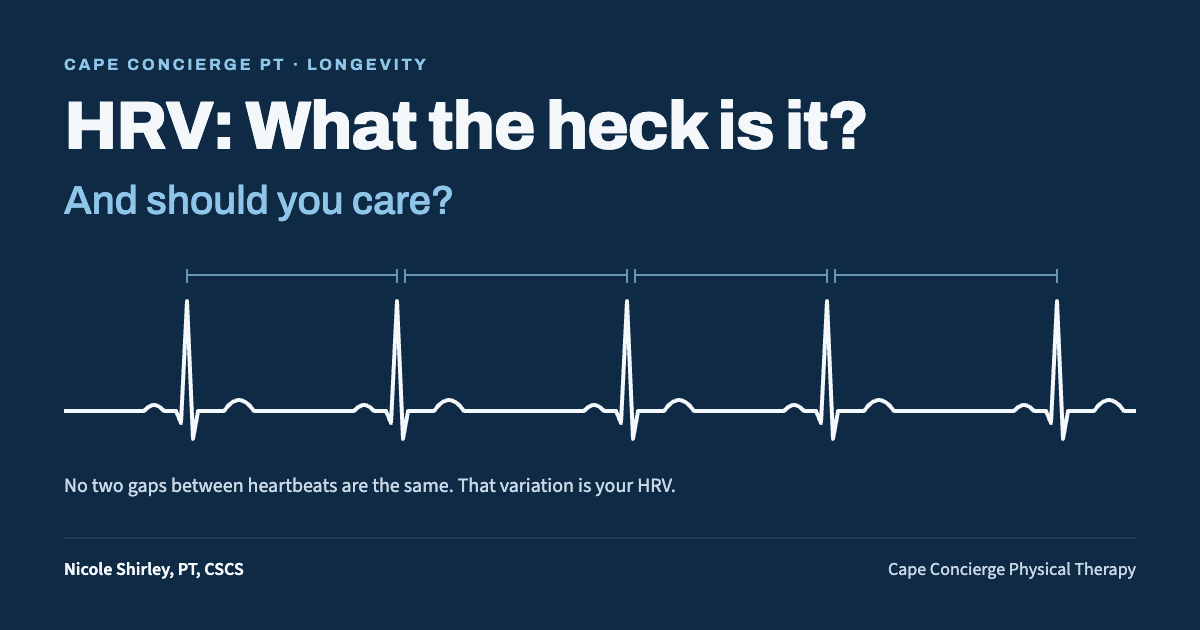
Heart rate variability is the tiny, natural variation in time between one heartbeat and the next. Your heart is not a metronome. Even at rest, the gap between beats shifts slightly, beat to beat.
That variation tells us how your nervous system is balancing its two main modes:
- The "calm" branch (parasympathetic): rest, digest, recover.
- The "alert" branch (sympathetic): go, push, handle the threat.
In general, higher HRV reflects a stronger calming branch and a body that adapts well. Lower HRV has been linked to chronic stress, poor sleep, and illness. In certain heart conditions, low HRV has also been associated with worse outcomes.
Here's the way I explain it in clinic: a flexible system is a resilient system. A body that can shift gears easily between "go" and "recover" shows more variability. A body stuck in "go" mode tends to show less.
How HRV is measured (and why your numbers may not match your friend's)
The gold standard is an ECG, which records your heart's electrical signal directly. Wrist and finger wearables use a light-based sensor (photoplethysmography) to estimate pulse variability. That's close to true HRV, but not identical.
Two more things make HRV numbers tricky to compare:
- Recording length matters. A quick spot check, a 5-minute recording, and an all-night recording all produce different numbers that can't be lined up side by side.
- There are several formulas. You may see RMSSD, SDNN, or HF power. Each emphasizes a different piece of nervous system activity.
Translation: an Oura number and a Garmin number are not the same currency. Compare yourself to yourself, on the same device.
How people actually use HRV
1. As a training readiness signal. Most trackers fold HRV into a daily "readiness" or "recovery" score. A noticeable drop that you can't explain otherwise is often read as accumulated physical stress and a cue to ease up. A higher reading is read as good recovery.
2. As a stress and wellness gauge. HRV is sensitive to stress, sleep quality, caffeine, alcohol, illness, and hydration. That's why many people track it overnight, when daytime movement can't throw off the reading.
3. As a tool to train your nervous system. HRV biofeedback pairs slow, paced breathing (roughly 6 breaths per minute) with real-time feedback on your heart rhythm. Research reviews and controlled studies show it can reduce perceived stress, anxiety, and depressive symptoms. The strongest evidence is in people with coronary heart disease, high blood pressure, or chronic pain. Evidence is weaker in diabetes and dementia.
That third one is the part I love. HRV isn't just something you measure. Your breath is a lever you can pull to influence it.
Should you care? Here's how to read your own numbers
Yes, but care about the trend, not the number.
HRV varies a lot from person to person based on age, sex, time of day, and plenty of short-term factors. There is no single "normal" HRV that applies to everyone, and a one-time reading doesn't tell you much on its own.
What matters is your own pattern over weeks, viewed alongside context: how you slept, how stressed you've been, whether you're getting sick.
A few honest caveats about wearables:
- They're reasonably accurate under good conditions, but tend to underestimate some HRV measures compared with ECG.
- Movement and irregular heartbeats can throw them off.
- They are useful trend trackers, not medical devices.
So if your HRV dips one morning, don't panic. If it's been sliding for two weeks and you feel run down, that's information worth acting on. And if you have questions about what your readings mean for your health, bring them to your clinician.
What moves your HRV (that you actually control)
The same things that make HRV sensitive are the things you can work on:
- Sleep: poor sleep shows up in your numbers.
- Stress: chronic stress keeps the "go" branch in charge.
- Alcohol and caffeine: both can nudge HRV in the wrong direction, especially later in the day.
- Hydration: easy to overlook, easy to fix.
- Illness: a dip can be an early heads-up that your body is fighting something.
- Training load: a sustained drop can mean you're stacking stress faster than you're recovering.
- Breathing: slow, paced breathing is the one tool built specifically to shift HRV.
Notice what's on that list. None of it is exotic. HRV just makes the basics visible.
The bottom line
HRV is a window into how well your nervous system shifts between pushing and recovering. It's worth watching if you use it the right way: compare yourself to yourself, look at trends over weeks, and read it alongside how you actually feel.
At Cape Concierge Physical Therapy, this is how we think about longevity: whole-system, not one number. Your HRV, your sleep, your strength, and how you move all tell part of the story.
If you want the full picture, start with a Movement Physical, our twice-yearly 3D Kinoteck movement screen. We'll look at how your body moves, where you're compensating, and build a plan that supports recovery, not just effort.
Refer yourself to physical therapy. No one else is going to do it for you.
— Nicole Shirley, PT, CSCS
References
This post is based on peer-reviewed research. If you'd like the full reference list, please email justin@capeconciergept.com.