
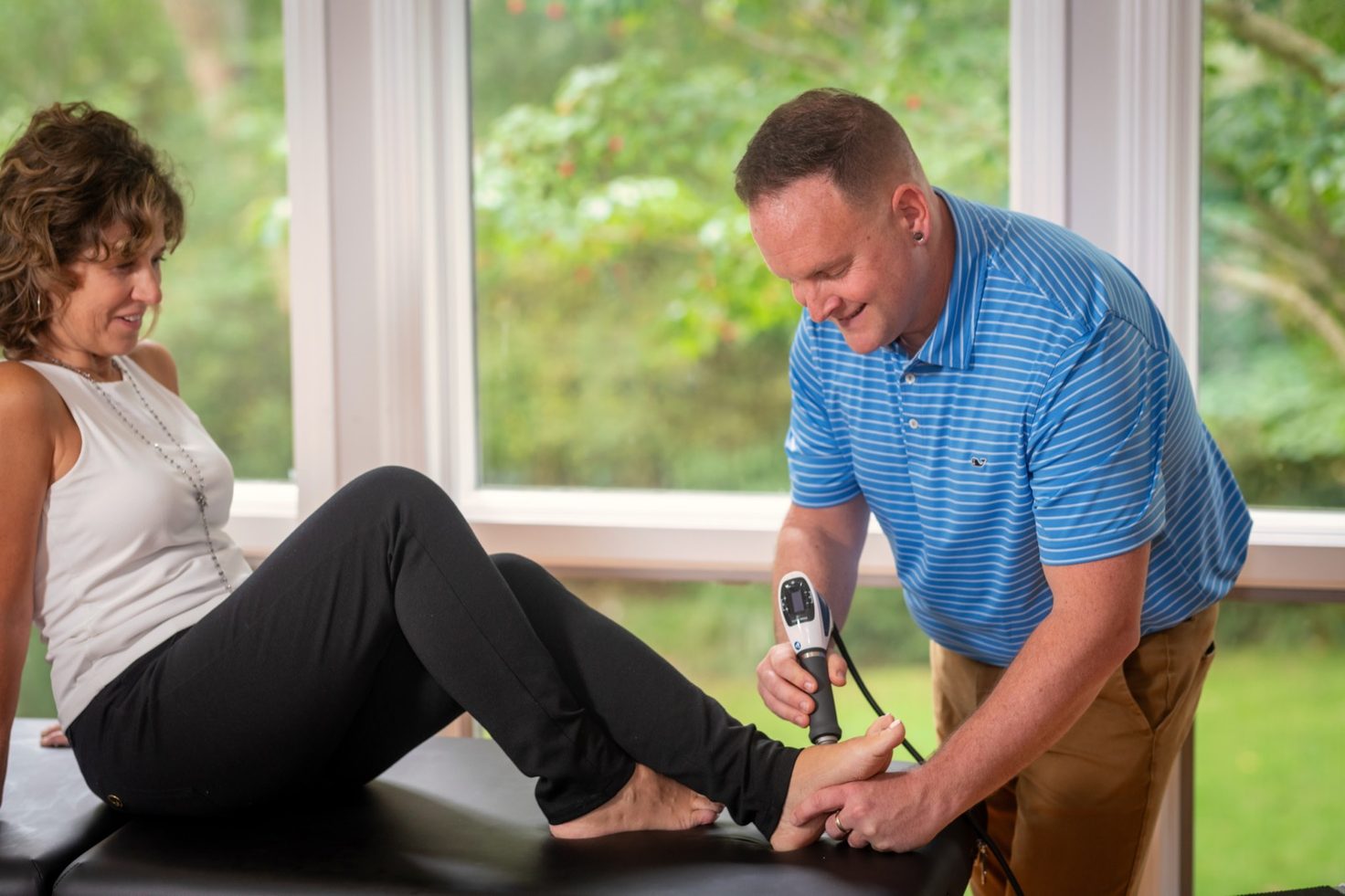
If you've researched shockwave therapy for a nagging tendon, hip, or shoulder issue, you've probably run into a wall of brand names — EPAT, ESWT, EMTT, radial, focused, "clinical grade," "FDA approved" — all promising the same thing: faster healing, less pain, no surgery. Some of that language is accurate. Some of it is marketing dressed up as science. Here's what the research actually supports, condition by condition, along with what we've observed treating these patients ourselves.
First, the terminology isn't as complicated as it sounds
"EPAT" (Extracorporeal Pulse Activation Technology) isn't a separate kind of technology — it's a trademarked brand name for radial pressure wave therapy (sometimes called rESWT).
"ESWT" (Extracorporeal Shockwave Therapy) usually refers to focused shockwave.
Different manufacturers brand the same underlying physics differently, which is where a lot of the confusion — and a lot of the marketing — comes from.
Radial pressure wave devices generate a pneumatic pulse that's strongest right at the skin surface and disperses as it travels deeper into tissue. They're well suited to broader, more superficial targets: plantar fascia, IT band, general trigger points, calcific tendonitis in the shoulder. (CCPT uses Radial).
Focused shockwave devices generate a wave that builds in intensity as it travels and peaks below the skin, at a specific depth. That makes them better suited to deeper, more localized targets — gluteal and hamstring tendinopathy.
This distinction matters more than the brand name does. A device's usefulness for a given condition depends more on whether it's radial or focused, and on the dosing protocol, than on which company made it.
Where the evidence is strongest:
Plantar fasciitis has the highest-quality evidence of any shockwave indication. A landmark randomized, placebo-controlled trial of focused ESWT found more than double the reduction in heel pain compared with placebo, and multiple subsequent meta-analyses have confirmed that shockwave outperforms corticosteroid injection at 3- and 6-month follow-up for pain, fascia thickness, and function. A 2023 systematic review rated the evidence for plantar fasciitis as high-quality, with benefits maintained out to 12 months.
Calcific tendinopathy of the shoulder also has strong support, particularly with focused ESWT delivered at higher energy doses.
Where the evidence is solid, if slightly less extensive:
Greater trochanteric pain syndrome / gluteal tendinopathy has a genuinely strong and growing evidence base. A 2025 systematic review found shockwave superior to corticosteroid injection in the long term, with a very large effect size — though the standard of care remains exercise and education first, with shockwave or injection as an effective add-on.
Proximal hamstring tendinopathy responds well to radial shockwave, which has outperformed conservative treatment alone in research.
Frozen shoulder (adhesive capsulitis) is an emerging but promising area. A large network meta-analysis of 92 trials ranked shockwave highest among nonsurgical treatments for restoring function, and separate research has found consistent benefit specifically in diabetic patients — a population where shockwave's ability to avoid the blood-sugar disruption of corticosteroid injections is a real clinical advantage.
Lateral epicondylitis (tennis elbow) may respond well in athletes and physically active individuals, though the evidence in the general population is more mixed — this is one where individual factors matter more than most.
The Menopause Connection
This is where the research gets particularly relevant to a lot of our patients. Estrogen decline during the menopause transition measurably reduces tendon collagen synthesis and turnover and increases susceptibility to tendinopathy — which is part of why gluteal tendinopathy, plantar fasciitis, and frozen shoulder show up so disproportionately in peri- and postmenopausal women. Frozen shoulder in particular is more common in women, and female sex has been identified in the research as a factor that influences how well patients respond to treatment.
There's also a steroid-sparing angle worth knowing about: for women managing blood sugar, bone density, or other metabolic concerns during this life stage, shockwave offers a way to treat these conditions effectively without the systemic effects of repeated corticosteroid injections.
There's even preliminary research suggesting high-energy shockwave may modestly support local bone density in postmenopausal patients with osteoporosis — an interesting, if still early, secondary benefit.
Not all "FDA cleared" claims mean the same thing
This is where patients — and honestly, a lot of providers — get misled. Most shockwave devices reach the market through the FDA's 510(k) pathway, which requires showing a new device is "substantially equivalent" to one already cleared. It does not require the manufacturer to run its own placebo-controlled trial. That's a legitimate, standard regulatory pathway, but it's a lower evidentiary bar than it sounds like to a layperson.
A smaller number of devices have gone through full FDA Premarket Approval (PMA) — the pathway that does require randomized, placebo-controlled trial data submitted directly to the FDA. The EMS Swiss DolorClast is a notable example, having received PMA specifically for chronic plantar fasciitis.
The practical takeaway: "FDA cleared" and "backed by clinical trial data submitted to the FDA" are not the same claim, even though marketing often blurs the two.
On the "our machine is more powerful" claims:
You'll sometimes hear device pressure output (measured in bar) presented as the deciding factor in which machine is "best." A few grounded facts: radial devices are pneumatically driven, and 5 bar is the practical, reliably calibrated ceiling for most reputable clinical-grade systems. Claims of 10 bar or higher should be scrutinized — they often reflect a different measurement convention rather than a genuinely more powerful, calibrated system. And higher pressure isn't automatically better outcomes anyway — energy flux density, correct depth targeting, and treatment protocol matter more than a single spec-sheet number.
What we see in our clinic:
The conditions we treat most often with shockwave are plantar fasciitis, golfer's and tennis elbow, frozen shoulder, shin splints (medial tibial stress syndrome), and Achilles tendonitis.
Here's how we explain the timeline to patients: if you break a bone or sprain a ligament, it takes about 6 weeks for a healthy body to heal it. Shockwave works on a similar principle — it's not an instant fix, it's a reminder to your body of how to heal itself. Generally, that "reminder" takes 3 sessions of radial shockwave, spaced a week apart, and most patients start to see significant improvement around 6 weeks out from that first session.
The single biggest factor in outcomes isn't the device — it's compliance. Patients who do the eccentric strengthening and mobility work alongside their shockwave sessions get better faster, and importantly, the symptoms don't come back. Shockwave without the rehab work is treating the symptom; shockwave with the rehab work is treating the actual problem.
Age and tissue quality also matter more than people expect. Younger patients respond faster — their tissue simply heals more efficiently. The older a patient is, and the more calcified the tendon, the longer the process takes. It's not entirely fair, but it's consistent, and it's part of why we set expectations up front rather than promising a universal timeline.
The clearest takeaway from our own experience: shockwave works best as part of a physical therapy plan, not as a standalone treatment. It's a tool that makes the rehab work more effective — it isn't a replacement for it.
What this means if you're considering shockwave therapy
The technology has a real, condition-specific evidence base, and it's genuinely useful when applied with the right device type and the right protocol. But "which brand is best" is less important than:
Is the device type (radial vs. focused) appropriate for your specific condition and its depth?
Is the provider trained in the specific application technique for your diagnosis — not just in operating the machine, but in dosing, depth, and treatment planning?
What's the actual evidence for your specific condition — not the technology in general?
That last question is the one most marketing conveniently skips. Shockwave isn't a single treatment with one evidence profile — it's a family of related technologies with different strengths, and the research should guide which one (and which protocol) fits your specific issue.
At Cape Concierge Physical Therapy we use the OrthoPulse 100 for radial shockwave therapy because this is the unit that we have read the most amount of research on.
This post is intended as general patient education and reflects publicly available research and FDA regulatory information as of 2026. It is not a substitute for individualized clinical evaluation.